Future Trends in Education
Learning Experience Design (LxD)
The future topic I’m focusing on is Learning Experience Design (LxD). This matters a lot to me because, honestly, everything around us has changed: how we travel, how we communicate, how we get information, even how we do medicine. However, schools? Classrooms? They look almost the same as they did over a century ago.










LxD is the direction education needs to move. It puts the spotlight on the actual human in the room, the learner. Who they are. What they care about. What they need (Kilgore, 2018). Instead of starting with content and forcing everyone to fit into one system, LxD begins with a simple question: Who are our learners? Once we understand that, then we can figure out the goals and design learning with students, not just for them. Students get a voice in deciding what needs to be learned and how they want to get there.
What are our LxD steps?
Figure out who your learners are.
Their backgrounds, strengths, and interests. What makes them who they are?.Identify their needs.
Academic needs, emotional needs, cultural needs, whatever supports or gets in the way of learning.Design learning around those needs
Build programs and activities that actually fit how they learn.Create LxD solutions and tweak as you go
Try ideas, get feedback, adjust.Put things into action and ask students how it went
Their feedback is data. Use it.Rinse, Fix, Repeat
Keep checking that all students are represented and supported.
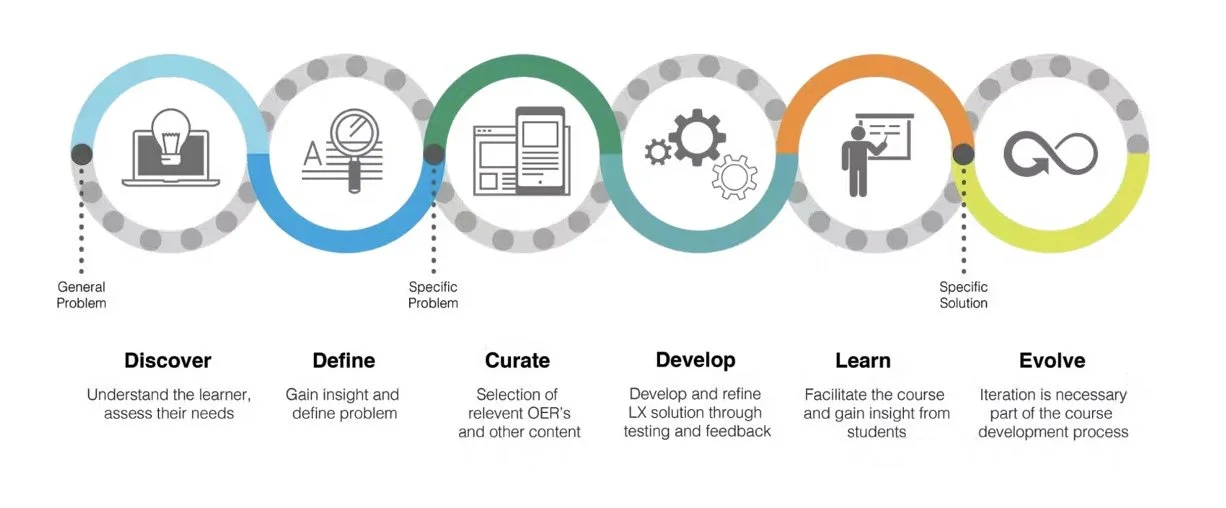
LxD Steps
Student Autonomy (And Why It Matters)
A big part of LxD is giving students more autonomy. Most students are used to what Freire calls the “banking model.” They sit there, and the teacher “fills them up” with information (Freire). It’s passive, and it doesn’t lead to deep learning.
LxD flips that. Students know the end goal, and with the teacher as a guide, they help design the steps to reach it. They choose the strategies that work for them. They decide how they want to show what they know. They “own it, learn it, share it (Lee & Hannafin, 2016).” Technology helps here, too. Letting students learn at their own pace, giving them different ways to access content, and helping teachers create flexible learning opportunities. Teachers shift into the role of designer, guide, and coach; still super important, but in a way that builds confidence and independence in kids.
Ungrading and LxD
Ungrading fits really naturally with LxD. Students may need time to understand it because it moves away from the traditional grade-focused mindset. But ungrading takes away a lot of the fear and pressure and puts the focus back where it should be, actually learning.
Students start to see whether they understand something or if they need more time, not whether they earned a “good enough” grade. When the process matters more than the grade, real learning shows up.
How Universal Design for Learning (UDL) Fits Into LxD
UDL fits right into the LxD model because it gives us a way to design for all the different types of learners we actually have. LxD asks, “Who are our learners, and how do we design for them?” and UDL helps answer that with real strategies.
UDL is basically the practical side of LxD. It reminds us to build in options from the start. Different ways to get information, different ways to stay engaged, and different ways to show understanding. It keeps us from designing for some“average” kid and helps make sure everyone can access the learning experience.
So LxD is the big picture, and UDL is one of the tools that makes that picture work for real humans in a real classroom.
At the end of the day, I want how we learn to feel real, relevant, and built for the kids actually sitting in front of us. LxD gives us the tools to finally make that happen.
Works Cited
Borysiak, K. (2025, April 23). From ID to LXD: What is a Learning Experience Designer?. YouTube. https://www.youtube.com/watch?v=VL9yRae5Krg
Freire, P. (n.d.). The “banking” concept of Education Paulo Freire. puente 2014. http://puente2014.pbworks.com/w/file/fetch/87465079/freire_banking_concept.pdf
Kilgore, W. (2018, December 27). UX to LX: The rise of Learner Experience Design - Edsurge News. EdSurge. https://www.edsurge.com/news/2016-06-20-ux-to-lx-the-rise-of-learner-experience-design
Kohn, A. (2016, February 21). Why Grades Shouldn’t Exist. YouTube. https://www.youtube.com/watch?v=lfRALeA3mdU
Lee, E., & Hannafin, M. J. (2016, January 7). A design framework for enhancing engagement in student-centered learning: Own it, learn it, and share it - educational technology research and development. SpringerLink. https://link.springer.com/article/10.1007/s11423-015-9422-5
Vergara Sanz, J. (2025, April 4). Empathetic design with Jimena Vergara Sanz. Think UDL. https://thinkudl.org/episodes/empathetic-design-with-jimena-vergara-sanz
